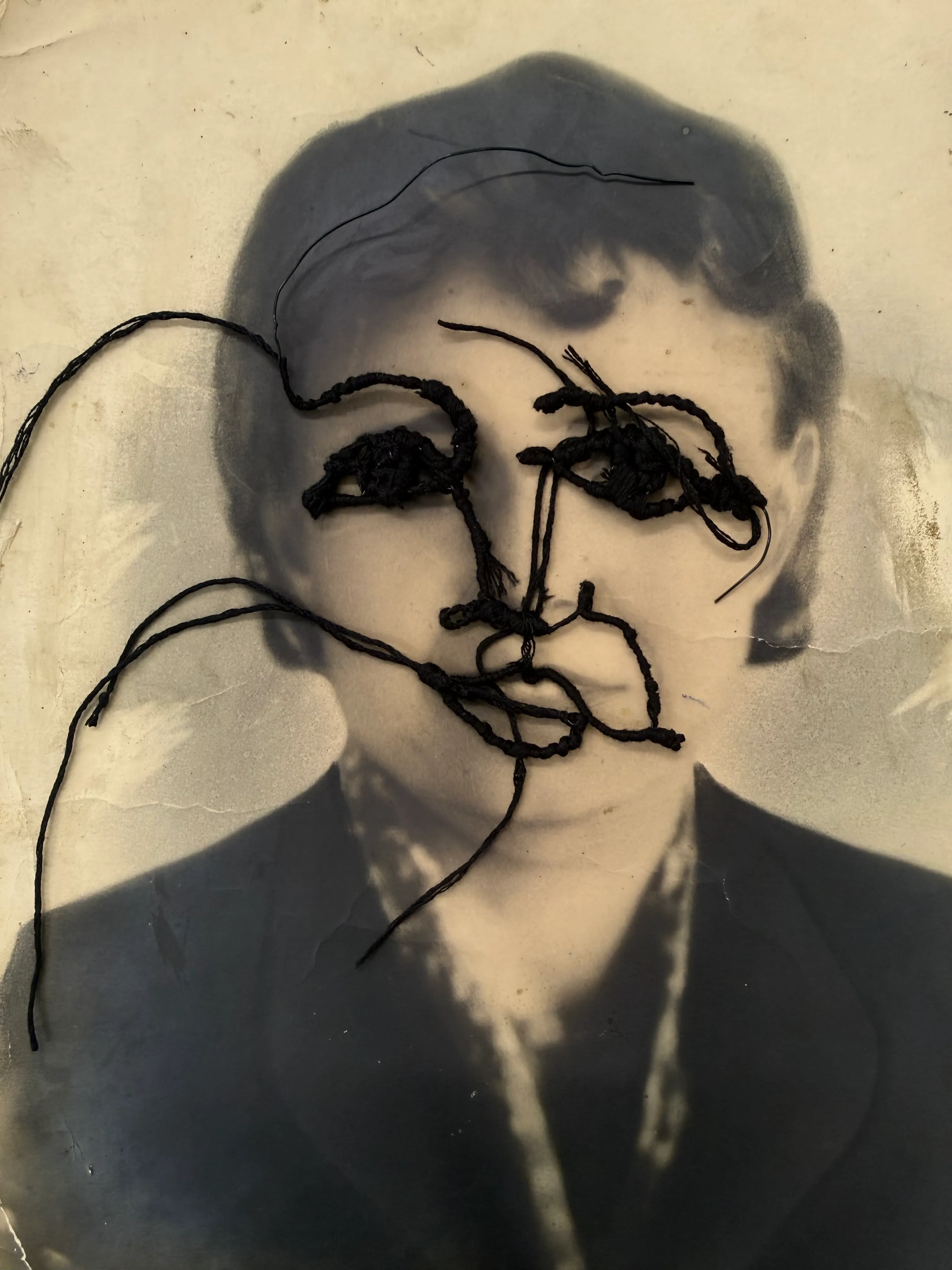
my scars will speak if I am to remain silent
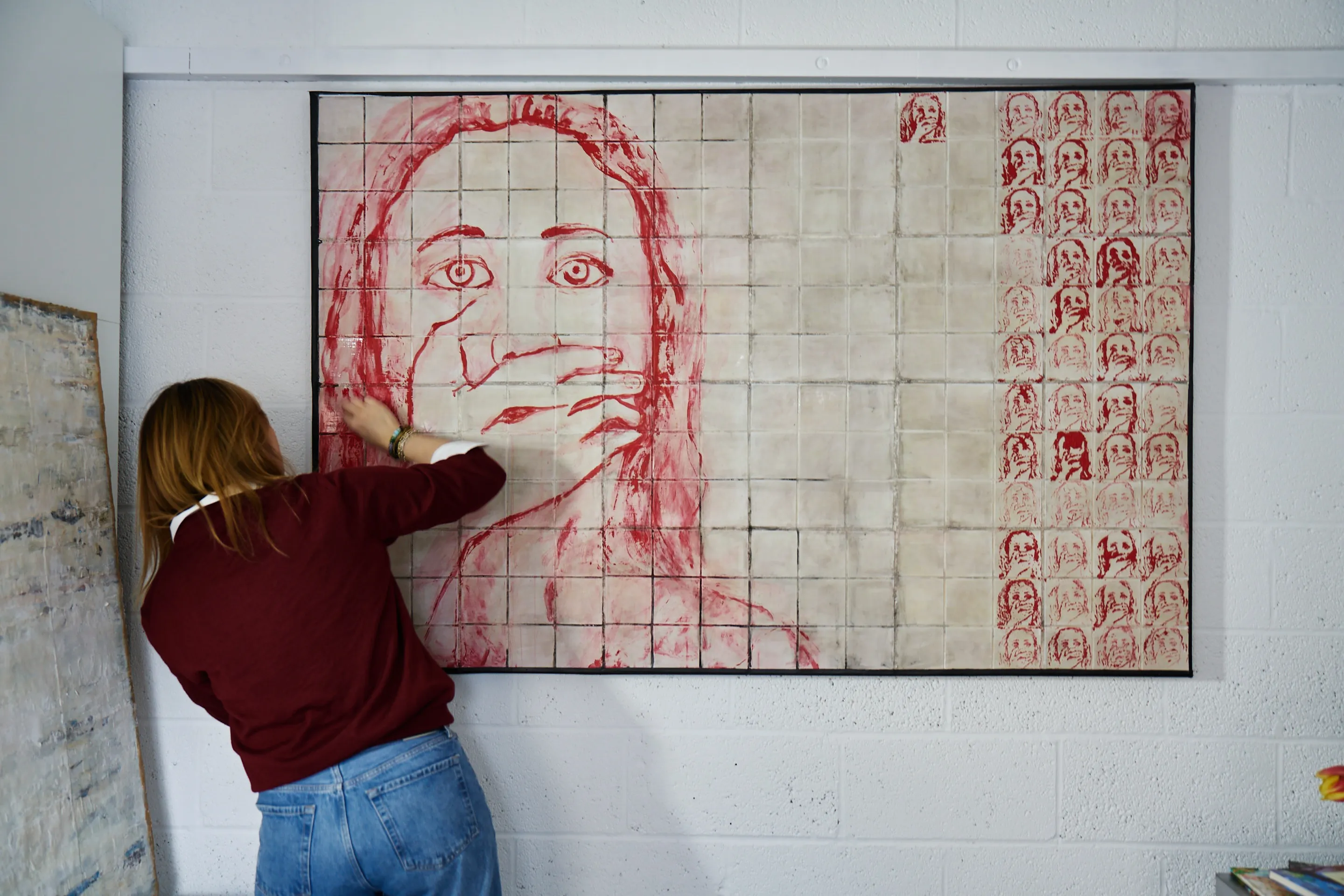
2020-ongoing
Poetry
Painting
Embroidery
Mixed media
Sketches
This project started as drawings and diary-like poems in Russian, which reflected the Belarusian uprising of 2020, which was brutally tamed by the regime. Today the project spans poetry in English, large scale mixed media works and drawings in watercolour pencil. Each element takes as its subject the women at the centre of the uprising: their bodies, their refusal to accept the standardised silence, and the forces arrayed against them. Together they move across registers — the compressed language of poetry, the slow accumulated labour of thread on linen, the overwhelming scale of a face that fills an entire wall — because no single form is sufficient to hold what happened, and what continues to happen in the land that birthed me.
Selected Works from this project:
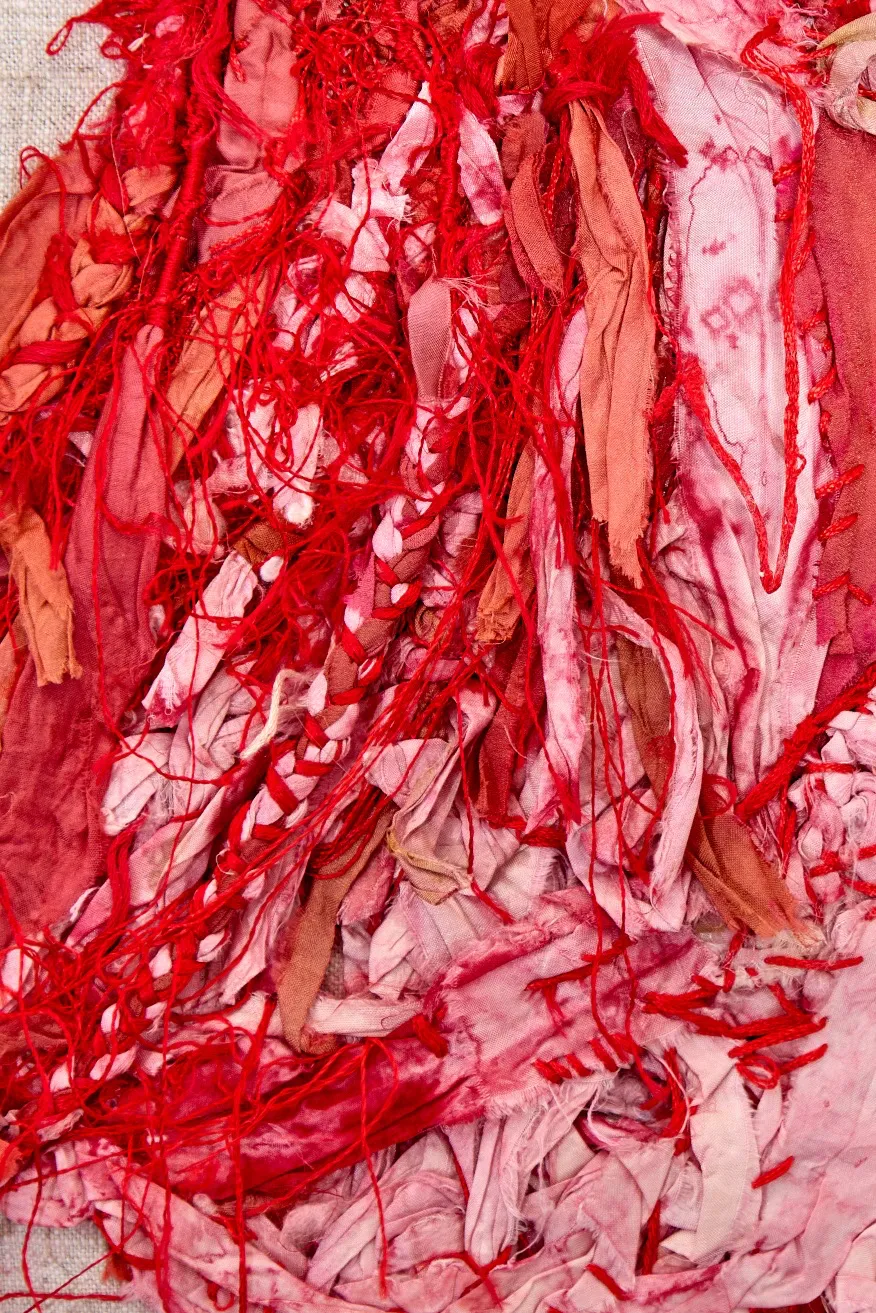
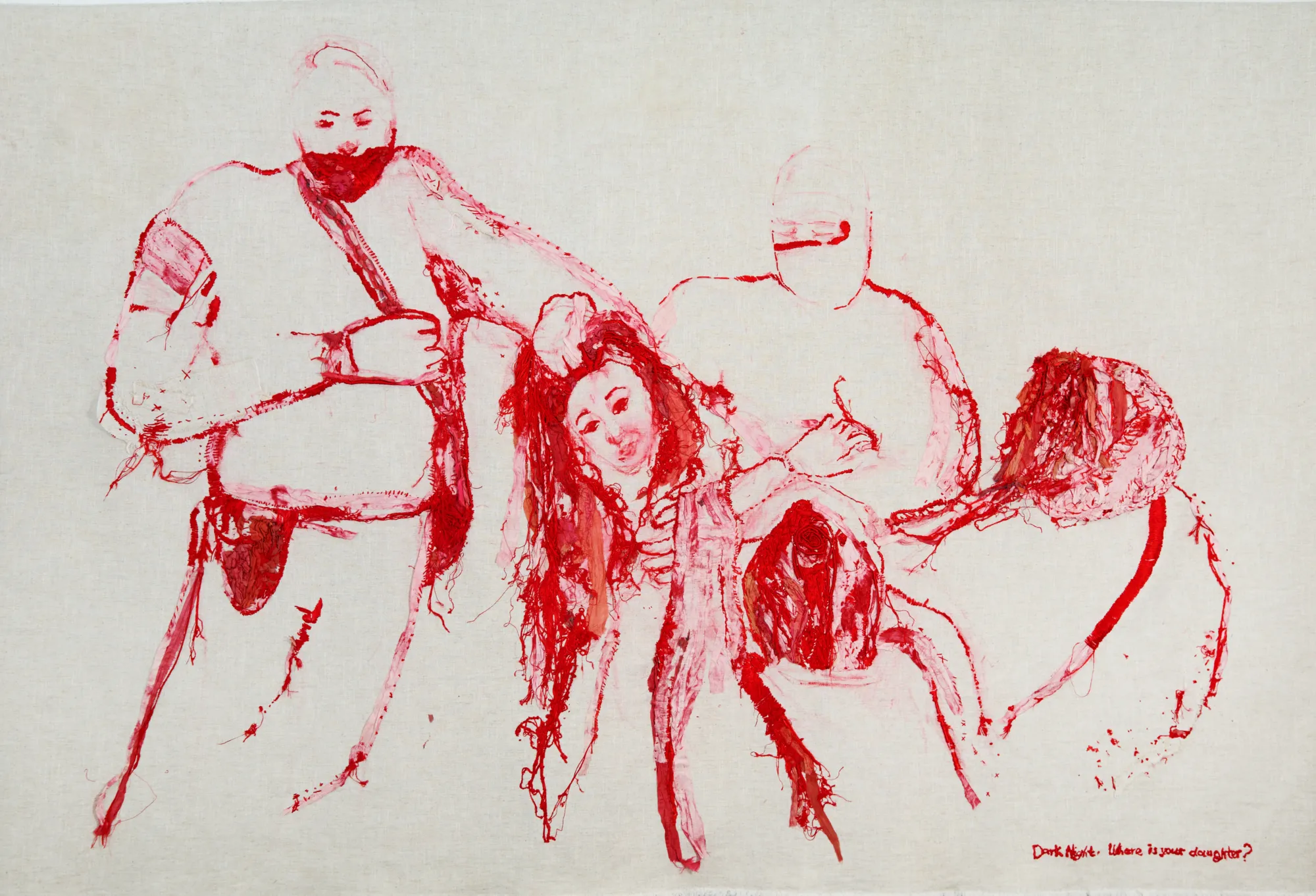
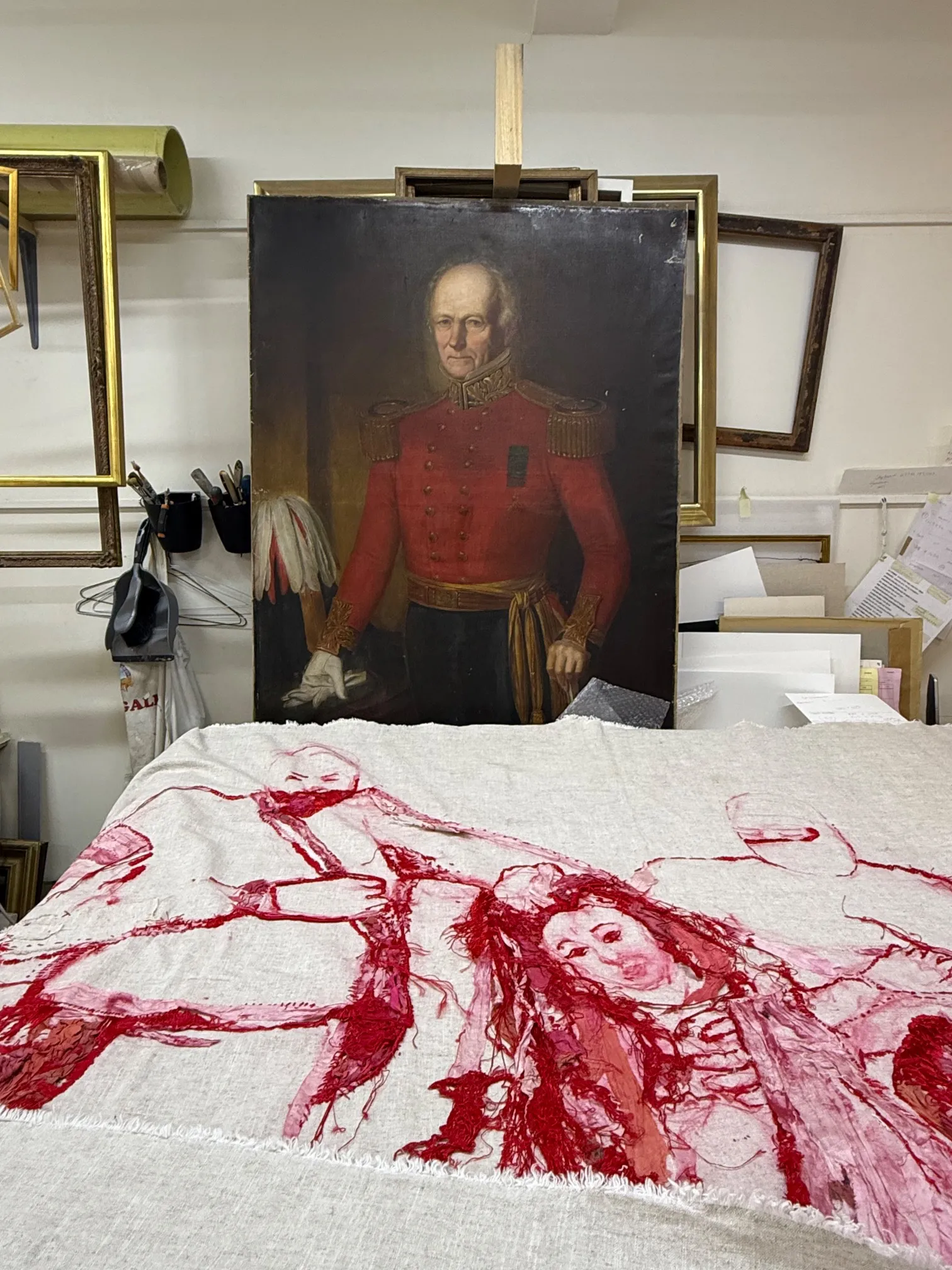
Dark Night Where is Your Daughter? (2022-2026). Against the raw, unhemmed expanse of natural linen, figures emerge from a single, unrelenting spectrum of red. The palette admits no other colour: every mark, every thread, every fragment of applied fabric exists within the range from pale blush to blood red, the work reads as a wound and a testimony, as a drawing and as a scar. The composition builds through complex layers — watercolour pencil, applied fabric, hand-stitched thread — each one visible and deliberate, accruing both physical relief and metaphorical depth as the surface lifts and gathers where materials accumulate, the histories the work carries pressing upward through the cloth. Watercolour pencil traces the first outlines and over these, hand-stitched thread and knotted silk accumulate at the work's points of greatest tension: the woman's wild, cascading hair; the torso's hollow centre; the rose form that sits at the heart of the image, densely wound and heavily stitched, like an emblem of everything the work contains. Two male figures flank the composition, their bodies solidly rendered but their faces left unresolved — authority without particularity. At the centre, a woman's face alone is fully realised, her features drawn with careful attention amid the surrounding turbulence.
The quality of sustained, laborious making is not incidental, it is a key element. Each stitch mirrors the sustained courage of those who returned to the streets of Minsk day after day in the summer and autumn of 2020, knowing what waited for them. The title draws from Kupalinka, an old Belarusian folk song — a mother's lament, sung into the dark — that was adopted as an anthem of the 2020 protest movement. In the Women in White Marches that followed the disputed presidential election, thousands of women dressed in white, carrying flowers, formed human chains across the city, placing their bodies between the crowd and the state. Dark Night Where is Your Daughter distils that moment: the contrast between the stillness and resolve of the central female figure and the surrounding force that presses against her. The question posed by the title is not merely rhetorical. It is a mother's question, a city's question — one that still goes unanswered for many Belarusian families.
The needlework is based on a drawing from the Red Drawings series (below).
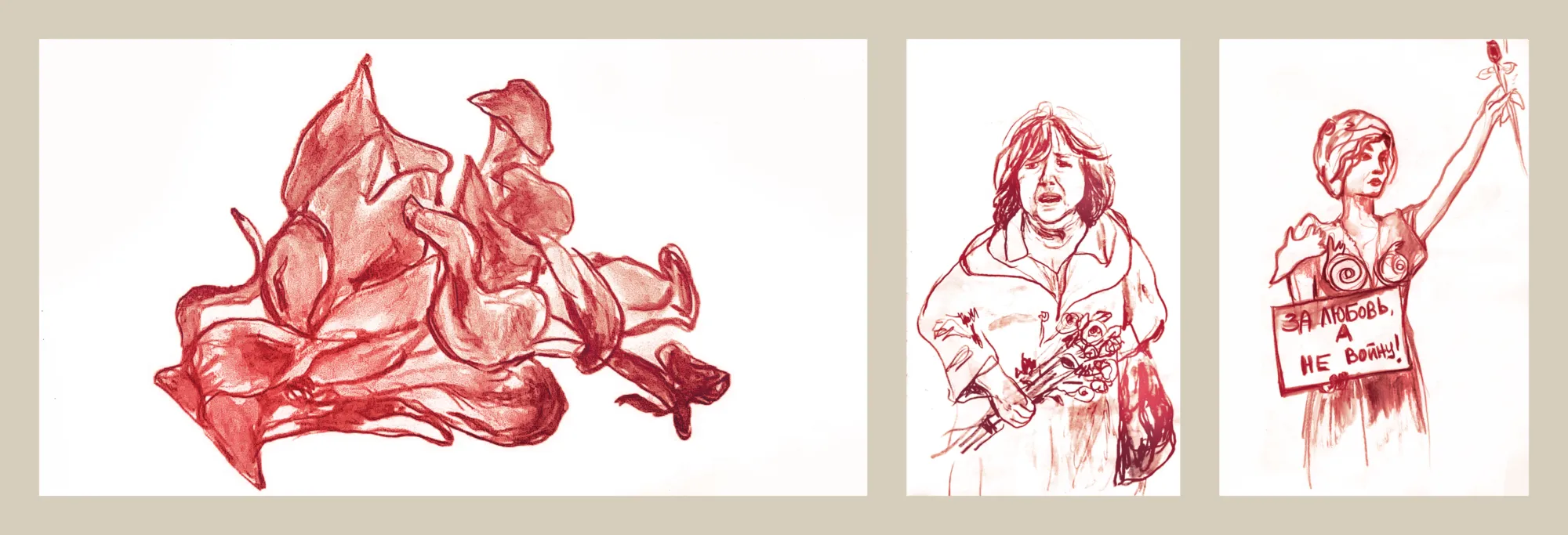
Red Drawings (2020-2021). This series of red monochrome drawings, about twenty in total, is based on documentary photographs from the women-led protests that swept across Belarus in 2020 after the contested presidential election. Rendered in bleeding crimson lines that evoke both ink and wound, the works transform moments of public resistance into intimate emotional fragments: flowers held like offerings, grief carried openly in the body, tenderness raised against violence. At the centre of the series stands Svetlana Alexievich, whose presence anchors the work historically and morally. As one of the few public intellectuals who remained in Belarus during the crackdown, Alexievich became both witness and symbol — her figure here emerging not as a portrait of authority, but as a vulnerable custodian of memory. The woman in a sculpture-like outfit to the left is holding a sign "To love, and not war".
The limited palette recalls emergency markings, censored archives, blood, lipstick, protest banners, and the fading residue of old photographs. The softness of the line resists monumentality; instead, the drawings preserve fragility, exhaustion, care, and human proximity. Flowers recur throughout the series as political objects: carried in marches by women dressed in white, they became emblems of peaceful defiance in the face of state brutality. Rather than depicting singular events, the works function as acts of remembrance — tracing how collective resistance is carried through ordinary gestures, female solidarity, and the persistence of witnessing.
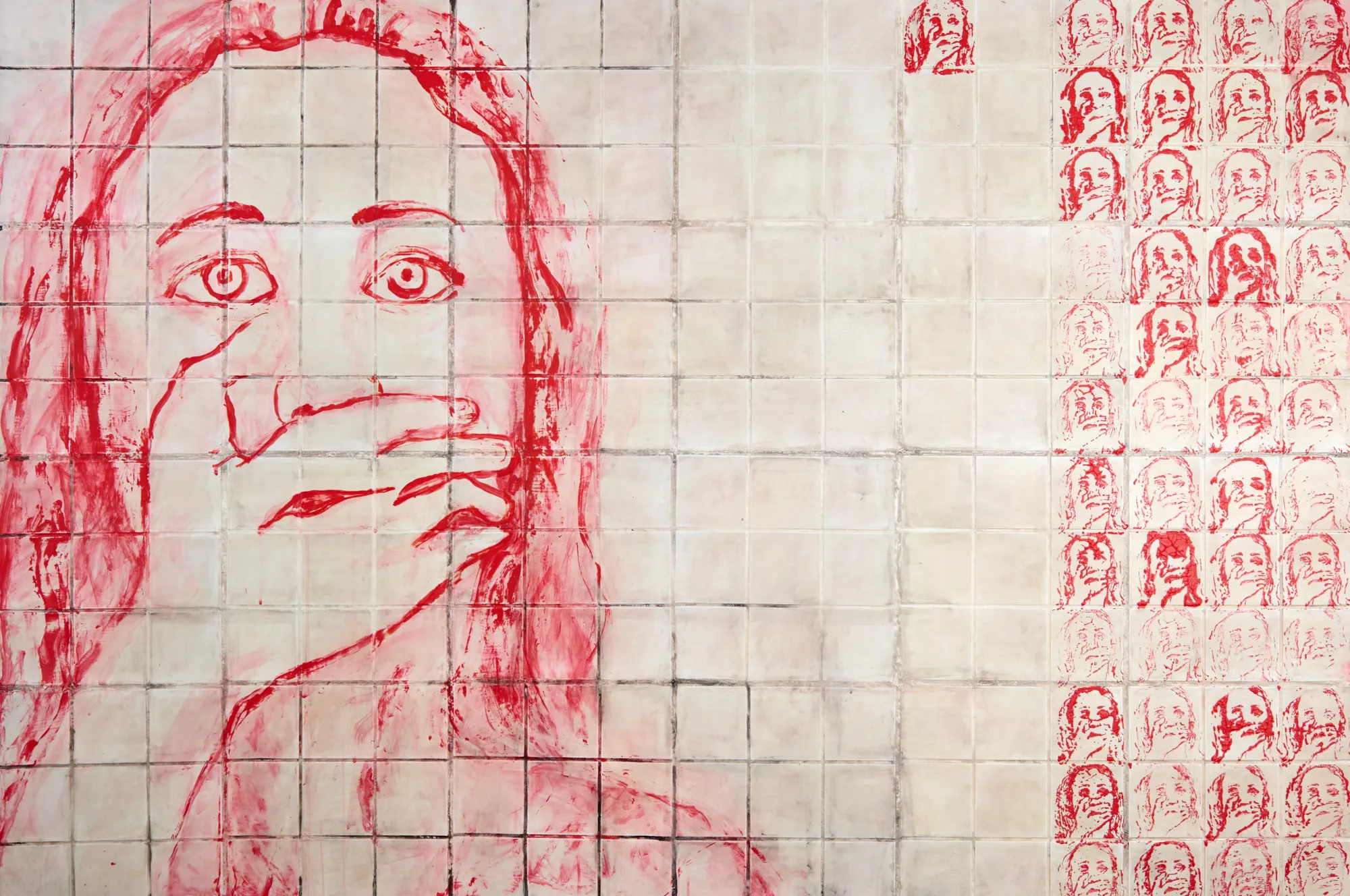
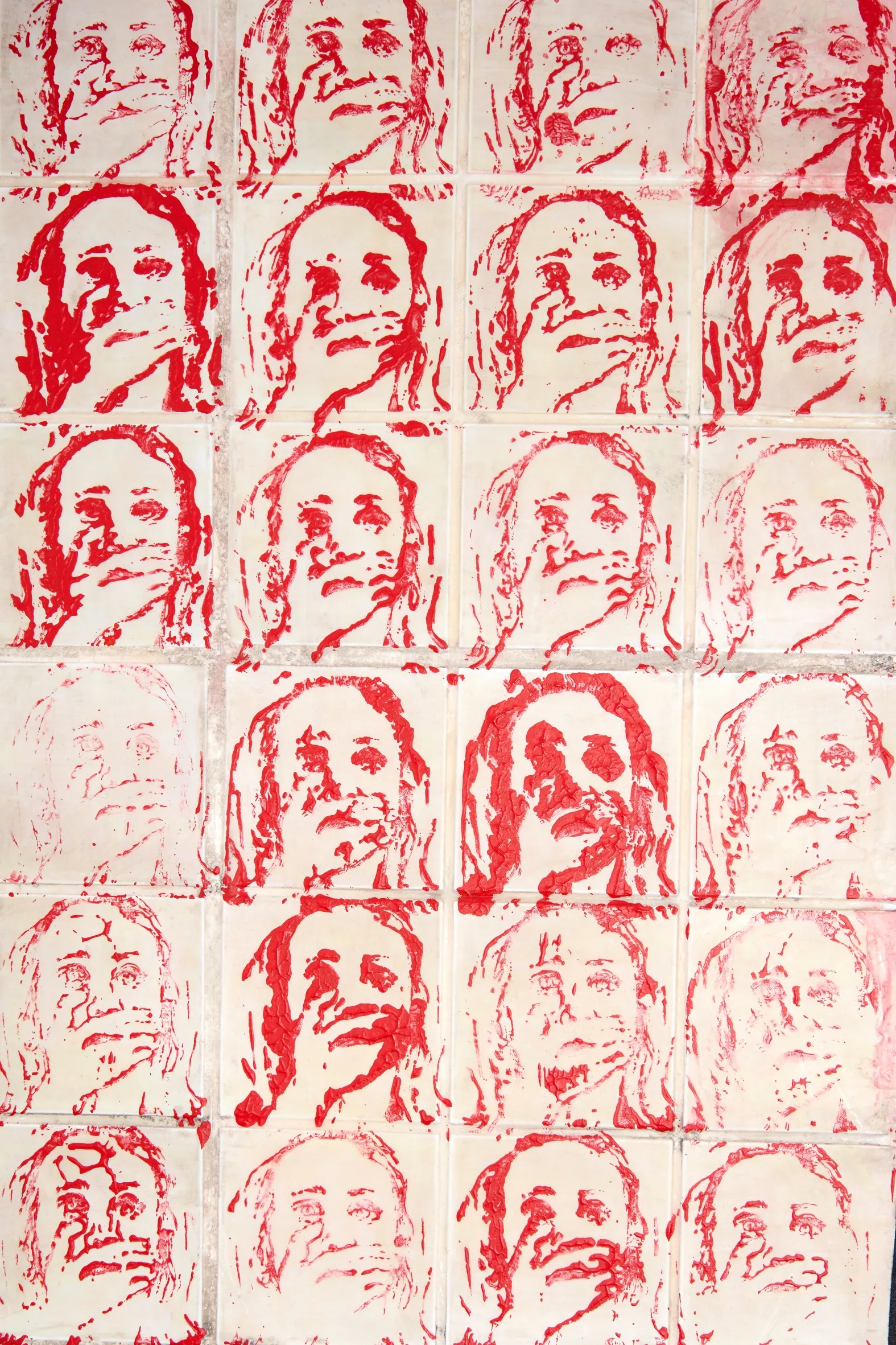
My Scars Will Speak if I am to Remain Silent" (2025) is a monumental mixed media work that confronts the viewer with the unbearable tension between self-silencing and the need to speak out. Spanning an entire wall at well over life size, the scale itself is an act of refusal – the face refuses to be ignored and cannot be minimised. At its centre, a portrait of a woman — rendered in blood-red paint across a grid of tiles — presses her hand so forcefully against her mouth that the gesture itself becomes a wound. Her eyes are wide open, unblinking, watching. Her hand does not comfort or conceal; it bleeds. Painted in a single continuous gesture across the tiled surface, this central figure radiates a rawness that is both deeply personal and unmistakably political. Surrounding her, and extending across the remaining tiles, the same face multiplies — printed repeatedly, fading in and out of view. The cold tiles, carry their own suggestions : the used extensively in hospitals, prisons, and state buildings — buildings in which bodies are processed and voices contained. The work originates in the image of a real Belarusian woman in the aftermath of the 2020 uprising — a woman covering her face not in grief, but in the effort remaining silent. This tiled wall, with its enlarged drawing printed across its surface, is intended as a testament to the silencing that prevails in many parts of the world — including, and urgently, in Belarus. The gesture of enforced silence is turned inside out: the title insists that silence is never total, that the body will always find a way to testify. The scars, here, are both literal and collective. They belong to one woman and to many.
Next project
You and I are earth